Have to and have got to break all of the rules that pure modal auxiliary verbs follow. Despite all of these differences, these semi-modal auxiliary verbs have several modal meanings. Modal auxiliary verbs, also commonly referred to as modal verbs or modals, are used to shift the meaning of the main verb in a clause.

These shifts include expressing possibility, ability, permission, obligation, or future intention. Students can find these confusing because one modal auxiliary verb can have multiple meanings depending on the context. Auxiliary verbs usually accompany an infinitive verb or a participle, which respectively provide the main semantic content of the clause. An example is the verb have in the sentence I have finished my lunch.

Here, the auxiliary have helps to express the perfect aspect along with the participle, finished. Some sentences contain a chain of two or more auxiliary verbs. Auxiliary verbs are also called helping verbs, helper verbs, or auxiliaries. Research has been conducted into split inflection in auxiliary verbs. In English there are two types of auxiliary verb, primary auxiliaries and modal auxiliaries.

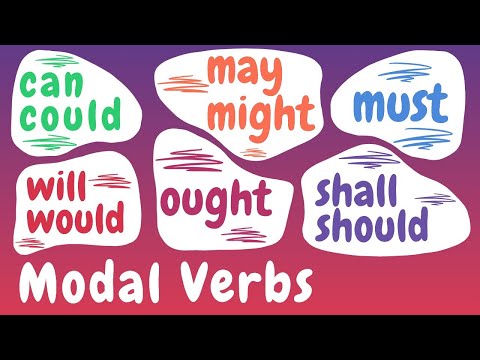
The three primary auxiliary verbs are 'be', 'have' and 'do'. … There are ten common modal auxiliary verbs and they are 'can', 'could', 'will', 'would', 'shall', 'should', 'may', 'might', 'must' and 'ought'. There are ten common modal auxiliary verbs and they are 'can', 'could', 'will', 'would', 'shall', 'should', 'may', 'might', 'must' and 'ought'. Some auxiliaries are usually called modal but often act to give grammatical information by forming a tense with a main verb. For this reason, some people will classifywill and would as Primary Auxiliary verbs.

That is a sensible approach because both verbs can act in both ways. The classification is then split so when they act as primary modal auxiliaries, that is what they should be called and likewise when they act as modal auxiliary verbs. The semi-modal auxiliary verb ought to ends in to, which makes the main verb an infinitive. This differs from pure-modal auxiliary verbs, which use the bare infinitive, the infinitive without to, for the main verb.

The meaning of ought to is nearly the same as should in all cases. When forming questions or negatives, should is more commonly used than ought to. Modal verbs and auxiliary verbs are verbs that help other verbs to show meaning. Auxiliary verbs indicate information such as tense, mood, voice and other grammatical aspects of the action. Modal verbs are a type of auxiliary verbs that indicate the modality.

This week´s blog is about primary auxiliary verbs and modal auxiliary verbs. In English there are three primary auxiliaries; they are 'BE', 'HAVE' and 'DO'. There are ten common modals; they are 'CAN', 'COULD', 'WILL', 'WOULD', 'SHALL', 'SHOULD', 'MAY', 'MIGHT', 'MUST' and 'OUGHT'. Modal auxiliary verbs are used to show a necessity, capability, willingness, or possibility.

Unlike most verbs, there is only one form of these verbs. Typically, verb forms change to indicate whether the sentence's structure is singular or plural. Most verbs also indicate whether something happened in the past, present, or future.
This is not the case with most modal auxiliary verbs, which makes them simpler to understand and use correctly. Remember that modal auxiliary verbs help verbs to form the meaning of a sentence and they cannot be used as main verbs nor do we put two modals together in a sentence. We cannot say «I will might go to the cinema tonight», we either say «I will go to the cinema tonight» or «I might go to the cinema tonight». Auxiliary verbs, or helping verbs, are usually used together with a main verb to add extra meaning to a sentence. They can also be used to conjugate verbs in compound tenses, to ask and answer yes-no questions or to express negation and the passive voice. The modal auxiliary verbs are never used as a main verb.
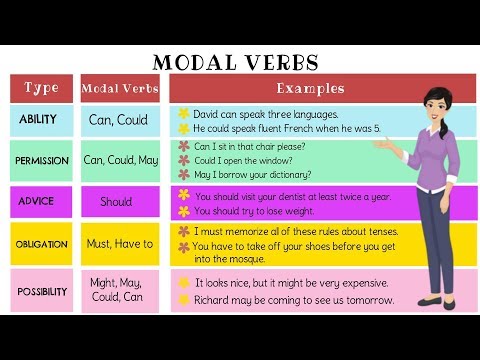
What Are Modal Auxiliary Verbs With Examples In addition, they do not have the five forms that main verbs have. While other auxiliary verbs can be used as a main verb and have the five forms, these modal auxiliary verbs do not. Auxiliary verbs are verbs that help the main verb to show its tense or form negation or questions.

They add extra information to the main verb such as time, tense, grammatical aspect, modality, voice etc. There are three common helping verbs in the English language. If the negative forms can't, don't, won't, etc. are viewed as separate verbs , then the number of auxiliaries increases.

The verbs do and have can also function as full verbs or as light verbs, which can be a source of confusion about their status. Modal verbs are defective insofar as they cannot be inflected, nor do they appear as gerunds, infinitives, or participles. The verbs be and have are used as auxiliary verbs to form different tenses of main verbs. Be is used on its own to form the continuous tenses, while have is used to form the perfect tenses.
Both have and been are used together to form the perfect continuous tenses. Be and have are used as auxiliaries to conjugate the continuous, perfect, and perfect continuous tenses. Do is used to make main verbs negative or to form interrogative sentences, and it can also be used to add emphasis to a sentence. The primary auxiliary 'BE' is used to form the continuous tenses and the passive voice.

The word «am» is the first person singular of the auxiliary verb 'BE'. We can also say «He was eating dinner when we got home». The word «was» is how we use the auxiliary verb 'BE' in the third person singular of the past tense. If I say «They will be playing tennis at two o´clock today» the words «will be» communicate the future.
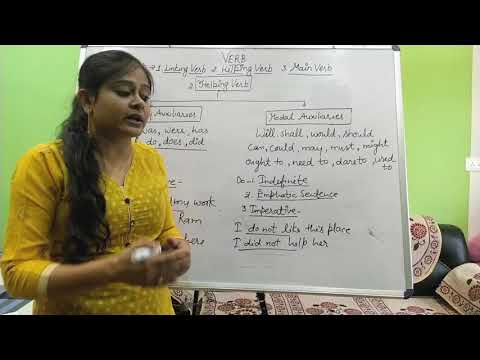
Apart from the verbs mentioned above, there is also a separate category of auxiliary verbs known as Modal verbs. This category includes Can, Could, May, Might, Must, Ought to, Shall, Should, Will, and Would. Modal verbs are a category of auxiliary verbs and are often known as modal auxiliary verbs.

They can express possibility, probability, ability, permission, obligation, etc. See the section on Conditional Verb Forms for help with the modal auxiliary would. The shades of meaning among modal auxiliaries are multifarious and complex.
Most English-as-a-Second-Language textbooks will contain at least one chapter on their usage. For more advanced students, A University Grammar of English, by Randolph Quirk and Sidney Greenbaum, contains an excellent, extensive analysis of modal auxiliaries. In both these cases the verb is followed by the past participle of a lexical or main verb and used to form what is called the passive voice. The passive is often used when the doer of the action is unimportant or unknown and to lay stress on the action itself and the object of the action.
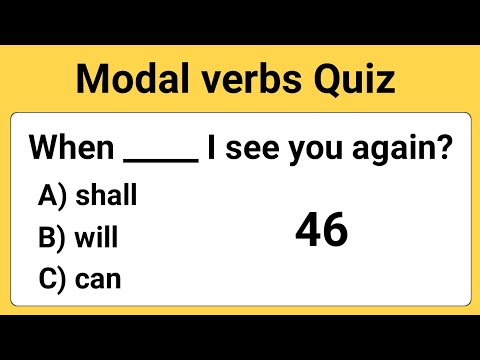
In sentence e., the auxiliary be is used alongside the auxiliary have so this sentence shows both perfect aspect and passive voice. To make an interrogative sentence , the modal auxiliary verb is inverted with the subject. Modals verbs are never used with other auxiliary verbs such as do, be, and have. The negative is formed by simply adding not after the modal verb, and the interrogative is formed by the inversion of the subject and the verb. Unlike auxiliary verbs, modal verbs never change form; they cannot be inflected.

Modal verbs may or may not be classified as auxiliaries, depending on the language. In the case of English, verbs are often identified as auxiliaries based on their grammatical behavior, as described below. In some cases, verbs that function similarly to auxiliaries, but are not considered full members of that class , are called semi-auxiliaries.
In French, for example, verbs such as devoir , pouvoir , aller , vouloir , faire , and laisser , when used together with the infinitive of another verb, can be called semi-auxiliaries. There has also been a study on auxiliary verb constructions in Dravidian languages. Since modal auxiliary verbs do not have a past tense form, we can use the modal auxiliary along with the word 'have' and a past participle. Past participles typically end in -d, -ed, -n, or -en, creating the past tense 'wished, looked, taken,' and so forth. Inversion refers to the reversal of the normal position of the subject and the auxiliary verb of a clause. We cannot use subject-verb inversion with main verbs to create interrogative sentences—we have to either add the auxiliary verb do, or else invert an existing auxiliary verb.

The ten common modal auxiliary verbs are used to express necessity and possibility. To remind us, the ten common modals are 'CAN', 'COULD', 'WILL', 'WOULD', 'SHALL', 'SHOULD', 'MAY', 'MIGHT', 'MUST' and 'OUGHT'. The modal auxiliary verbs are auxiliary verbs that specifically affect the mood of the verb. Remember that verb mood is about the attitude in which the action or state is expressed-as a statement of fact or opinion, as a wish, as a possibility, or as a command. When this occurs, perfect aspect is superior to progressive aspect, e.g.

Prepared list of sentences using a wide range of modal auxiliary verbs . Modal auxiliary verbs like can, may, ought, shall, and wood are used to suggest an impending or possible upcoming action. Learn to identify modal auxiliary verbs, understand their purpose, and indicate past tense with the provided examples. You may have noticed that the future tenses also use the auxiliary verb will. This is one of the modal auxiliary verbs, which will be covered in a separate section.

The primary verbs in English grammar are the verbs be, have, and do—all three of which can function as either main verbs or auxiliary verbs. We use the primary auxiliary 'HAVE' to form the perfect tenses. These tenses include the present, past and future perfect, the perfect continuous and the perfect conditional tenses.

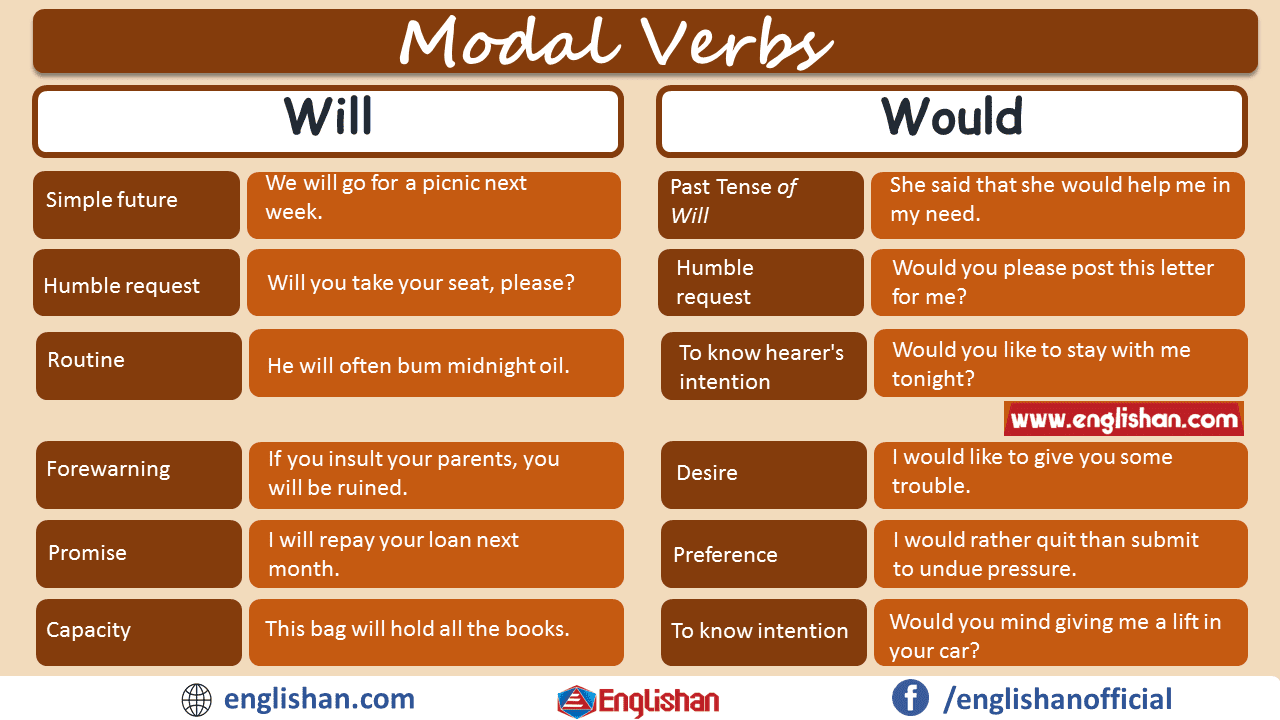
To make a sentence using the present perfect tense we use the word 'have' and a past participle, for example «I have watched television all day». Had better is a two-word semi-modal auxiliary verb that has the same characteristics as pure modal auxiliary verbs. Will is becoming much more common than shall, and this trend seems to be continuing. The next two tables illustrate some of the similarities and differences between these two modal auxiliary verbs. Auxiliary verbs are used together with a main verb to show the verb's tense or to form a negative or question. Fred may be being judged to have been deceived by the explanation.Viewing this sentence as consisting of a single finite clause, it includes five auxiliary verbs.

From the point of view of predicates, judged and scrutinized constitute the core of a predicate, and the auxiliary verbs contribute functional meaning to these predicates. These verb catenae are periphrastic forms of English, English being a relatively analytic language. Other languages, such as Latin, are synthetic, which means they tend to express functional meaning with affixes, not with auxiliary verbs. The following sections consider auxiliary verbs in English. They list auxiliary verbs, then present the diagnostics that motivate this special class (subject-auxiliary inversion and negation with not). The modal verbs are included in this class, due to their behavior with respect to these diagnostics.

Auxiliary verbs typically help express grammatical tense, aspect, mood, and voice. The auxiliary verbs of a language form a closed class, i.e., there is a fixed, relatively small number of them. Write down all the sentences with modal auxiliary verbs. Indicate what type of modal auxiliary verb is used in each sentence.
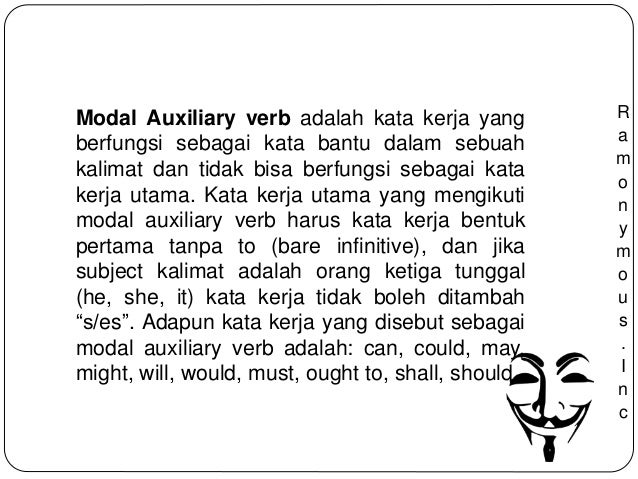
Other helping verbs, called modal auxiliaries or modals, such as can, could, may, might, must, ought to, shall, should, will, and would, do not change form for different subjects. For instance, try substituting any of these modal auxiliaries for can with any of the subjects listed below. Let's take a look at ought to, had better, have to, be able to, used to, and be supposed to.
We'll explain some of the reasons why these are not always categorized as modal auxiliary verbs. You'll also see some examples demonstrating their modality. The nine pure modal auxiliary verbs, will, shall, can, could, may, might, must, would, and should, share the same characteristics. Many sources and student textbooks do not differentiate between pure modal auxiliary verbs and semi-modal auxiliary verbs, and others separate them completely.

Some syntacticians distinguish between auxiliary verbs and light verbs. The two are similar insofar as both verb types contribute mainly just functional information to the clauses in which they appear. This activity will get students up and moving while they practice what they have learned about modal auxiliary verbs. The special verbs can, could, may, might, will, would, shall, should, must, ought, dare and need are called modal auxiliary verbs. Because of the flexibility of this verb , it is important to pay close attention to how it is used.

When it is used as an auxiliary, like the primary and modal verbs, it will occupy the initial position in the verb phrase, and there will always be a non-finite lexical verb to follow. When it is used as a lexical verb, it may be preceded by an auxiliary verb or simply stand alone." You can see from that little exercise that it is not easy to disentangle the meanings in all cases.


No comments:
Post a Comment
Note: Only a member of this blog may post a comment.